
Tooth Decay Stages: What’s Happening Inside Your Teeth (And How to Stop It)
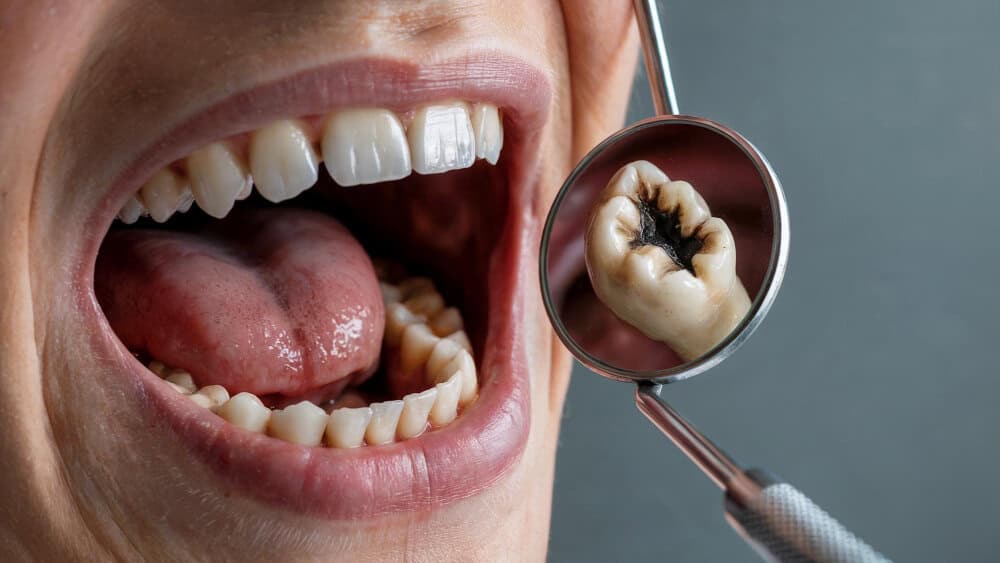
Most people don’t notice tooth decay until something hurts. By that point, the damage has usually been building for months — sometimes longer. The truth is, tooth decay doesn’t happen overnight. It moves through distinct stages, and the earlier it’s caught, the simpler the treatment.
This guide walks you through what tooth decay actually is, how it progresses, what can be done at each stage, and how to stop it from starting in the first place.
What Is Tooth Decay?
When oral bacteria produce acids that progressively erode and weaken tooth structure, tooth decay results. When you eat or drink — especially sugary or starchy foods — bacteria feed on those sugars and release acids as a byproduct. Over time, those acids dissolve the minerals in your enamel, weakening it layer by layer.
It’s a progressive process. What starts as microscopic mineral loss can eventually work its way through the enamel, into the dentine, and all the way to the pulp at the centre of the tooth.
But here’s the important part: tooth decay is both preventable and treatable, particularly when it’s identified early.
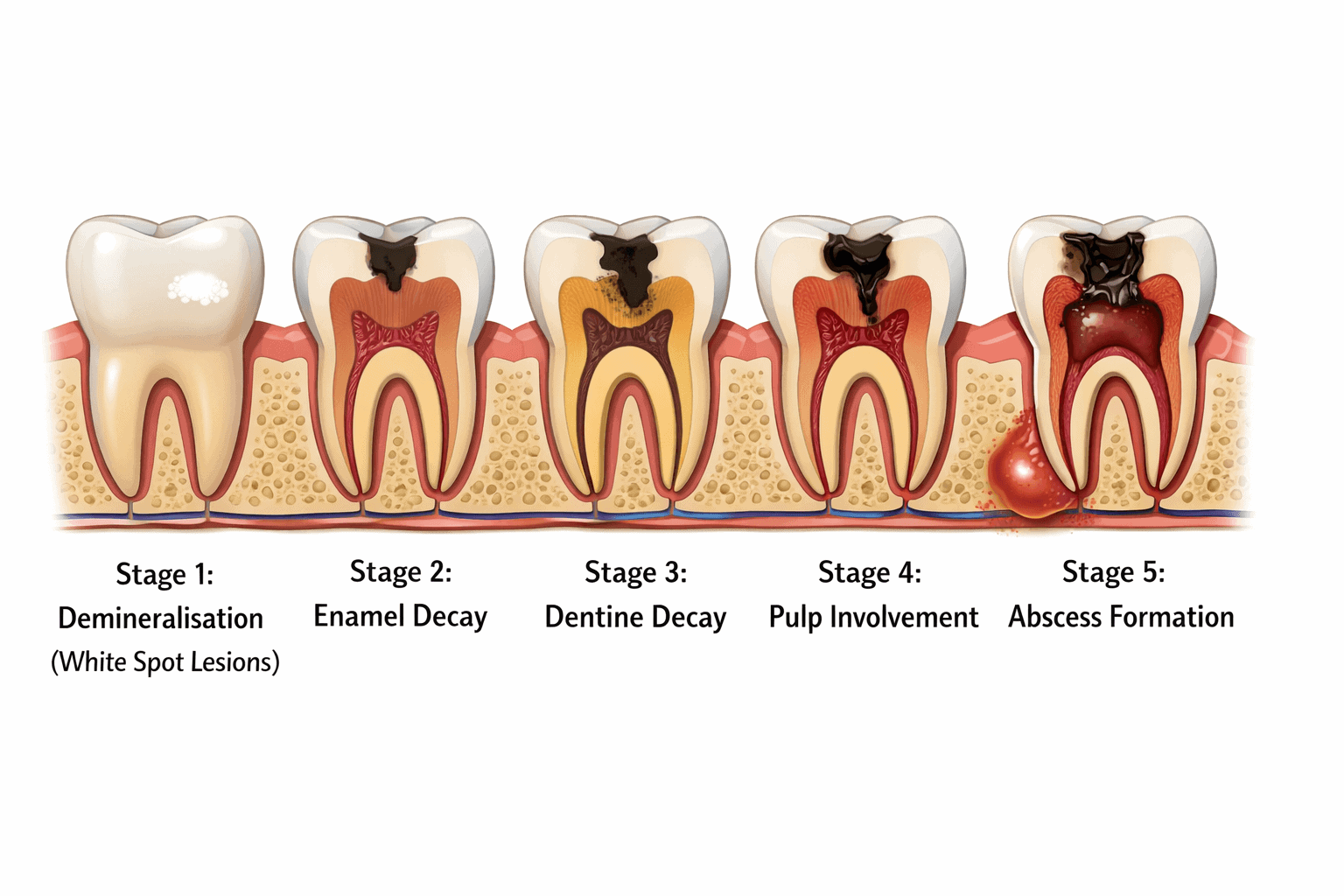
The 5 Stages of Tooth Decay
Understanding how decay progresses helps you recognise why regular dental visits matter — and why waiting until there’s pain is never the best approach.
Stage 1: Demineralisation (White Spot Lesions)
This is the earliest sign of decay. You might notice chalky white spots on the surface of a tooth. These appear when acid attacks begin stripping minerals — mainly calcium and phosphate — from the enamel.
At this stage, the damage hasn’t broken through the enamel surface yet. The tooth structure is still intact. This is the only stage at which decay can be reversed without drilling.
Stage 2: Enamel Decay
If demineralisation continues unchecked, the enamel begins to break down. The white spot may darken to a brownish colour, and eventually a cavity — a small hole — forms in the tooth’s surface.
Once enamel is lost, it doesn’t grow back. A dental filling is typically needed at this point, but treatment is still straightforward.
Stage 3: Dentine Decay
Below the enamel sits dentine — a softer, more porous layer that surrounds the nerve. Decay spreads faster through dentine than enamel. You may start to notice sensitivity to hot, cold, or sweet foods at this stage, though some people still feel nothing.
A filling can often still address decay caught here, though a larger one may be required depending on how much dentine is affected.
Stage 4: Pulp Involvement
The pulp is the living tissue at the centre of the tooth — it contains nerves and blood vessels. When decay reaches this point, it typically causes significant pain, swelling, or prolonged tooth sensitivity.
At this stage, root canal therapy is typically performed to clear the infected pulp, and a crown is then placed to rebuild and protect the tooth.
Stage 5: Abscess Formation
In the most advanced stage, infection spreads beyond the tooth root into the surrounding bone and tissue, forming an abscess. This is a dental emergency. Common signs include intense, persistent pain, swelling around the face or jaw, fever, and an unpleasant taste that persists.
If the tooth is restorable, root canal therapy may still be an option — though in some cases, removal is the only remaining option. The infection may also require antibiotics.
How to Prevent Tooth Decay
With the right daily routine and routine visits to your Leederville dentist, most tooth decay can be avoided altogether.
- Brush properly — twice a day, every day. Use a fluoride toothpaste and brush for a full two minutes, morning and night. Fluoride supports enamel by restoring lost minerals, making it one of the most reliable defences against cavities.
- Floss daily. Cavities don’t only form on the tops of teeth — they form between them too, in spaces your toothbrush can’t reach. Daily flossing clears away plaque and trapped food from between teeth — areas your toothbrush can’t reach.
- Limit sugar and acidic foods. It’s not just how much sugar you consume — it’s also how often. Frequent snacking keeps your mouth in a more acidic state for longer, giving bacteria more opportunities to cause damage. Regularly sipping on soft drinks, sports drinks, or fruit juices exposes your enamel to repeated acid attacks that wear it down over time.
- Drink water, particularly fluoridated tap water. Water is one of the simplest things you can do for your teeth — it clears away leftover food and bacteria, and, if it’s fluoridated tap water, it quietly strengthens your enamel throughout the day.
- Visit your dentist regularly. A dental examination every six months allows your Leederville dentist to spot the early signs of decay — including Stage 1 lesions — before they require invasive treatment. Professional cleans also remove hardened tartar that brushing alone can’t shift.
- Ask about fissure sealants. Sealants work by covering the uneven grooves on the chewing surfaces of back teeth — spots that are notoriously difficult to keep clean and where decay often starts. They’re particularly useful for children and teenagers, but can be appropriate for adults too.
Cavity Treatment at Each Stage
Treatment becomes more involved — and more costly — the further decay progresses. Here’s what to expect at each stage:
- Stage 1 — Remineralisation: No drilling required. Fluoride treatments, improved oral hygiene, and dietary adjustments can reverse early mineral loss and halt decay in its tracks.
- Stage 2 — Composite Filling: Once a cavity forms in the enamel, a filling is placed to restore the tooth. Modern tooth-coloured composite fillings are durable and blend naturally with the tooth.
- Stage 3 — Larger Filling or Crown: Depending on the extent of dentine involvement, a standard filling may still be possible. In some cases, a dental crown may be needed to provide adequate structural support.
- Stage 4 — Root Canal Treatment: The procedure involves removing the damaged pulp, thoroughly cleaning and sealing the root canals, and fitting a crown to bring the tooth back to full function.
- Stage 5 — Extraction or Emergency Treatment: If the tooth cannot be saved, extraction is performed. The resulting gap can be restored with a dental implant, bridge, or denture to maintain function and appearance.
The pattern is clear: earlier detection means simpler, less invasive treatment. Every stage you can prevent or catch early, you don’t have to treat.
Risk Factors for Tooth Decay
Anyone can develop cavities, but certain factors increase the likelihood:
- Dry mouth (xerostomia): Saliva is essential for keeping the mouth healthy — it buffers acid and helps clear away harmful bacteria after eating. Reduced saliva flow — caused by certain medications, medical conditions, or mouth breathing — significantly increases the risk of tooth decay.
- Frequent snacking: Every time you eat, your mouth enters an acid phase that lasts roughly 20–30 minutes. Grazing throughout the day extends this window considerably.
- Acidic and sugary drinks: Regular consumption of soft drinks, energy drinks, or fruit juices repeatedly bathes the teeth in acid.
- Poor oral hygiene: When brushing is irregular, and flossing is skipped, plaque accumulates quickly and creates the conditions bacteria need to cause damage.
- Insufficient fluoride: Without adequate fluoride — through toothpaste, water, or professional application — enamel is less protected against acid erosion.
- Deep tooth grooves: Some people naturally have deeper fissures in their back teeth, which trap food and plaque more easily. Sealants can help address this.
Frequently Asked Questions About Tooth Decay
Can you reverse a cavity?
Only at Stage 1 — demineralisation. At this point, mineral loss hasn’t broken through the enamel surface, and remineralisation with fluoride and improved hygiene can stop and reverse the process. Once a cavity forms, it requires a filling.
How do I know if I have tooth decay?
Early-stage decay often has no obvious symptoms, which is why regular dental visits are important. Signs to watch for include white or brown spots on teeth, sensitivity to hot, cold, or sweet foods, a visible hole or dark area on a tooth, and a toothache. Pain typically appears in the later stages.
Is tooth decay genetic?
Genetics can play a role — factors like enamel quality, saliva composition, and tooth shape are partly inherited. However, decay is primarily driven by oral hygiene habits, diet, and professional care. A genetic predisposition doesn’t make cavities inevitable.
Does sugar-free mean safe for teeth?
Not necessarily. Sugar-free products don’t feed the bacteria that cause decay. However, many sugar-free drinks — particularly flavoured sparkling waters and diet soft drinks — are still highly acidic and can erode enamel over time. Water remains the safest choice for your teeth.
Tooth Decay Treatment in Leederville
If you’re concerned about tooth decay — or you haven’t had a check-up in a while — our team at Dentists on Vincent Leederville is here to help. We see patients from Leederville, Mount Hawthorn, North Perth, West Leederville, and Wembley, and we focus on catching problems early so treatment stays as straightforward as possible.
Whether you’re due for a routine examination, noticing some sensitivity, or want to talk through prevention options, we’d love to see you.
Call us on (08) 9242 4400 or book your appointment online. You’ll find us at 322 Vincent Street, in Leederville.
Book Your Consultation Today!
- We accept Eftpos, Mastercard, Visa Card, HICAPS and All Major Health Funds.
Contact Info
Dentists on Vincent Leederville
Address: 322 Vincent St, Leederville, WA 6007
Phone: (08) 9242 4400
Opening Hours
Mon: Closed
Tue: 9:30 AM – 5:30 PM
Wed: 9:30 AM – 6:30 PM
Thu: 9:30 AM – 5:30 PM
Fri: 9:00 AM – 3:30 PM
Sat: 8:30 AM – 12:30 PM (by appointment)
Sun: Closed
PARKING/PUBLIC TRANSPORT
There is ample car parking across the road from the practice
There are cafes and eateries within walking distance
LOCATION
Dentists on Vincent is located in Leederville, 14 min from Northbridge and only short stroll from Leederville Oval and Water Corporation
Leederville dentist also serving local communities in West Leederville, Northbridge, North Perth, Wembley, Floreat, Mount Hawthorn, Subiaco, Menora, Coolbinia and Jolimont.